


Best Credit Cards in 2026
How to Compare Rewards, Cashback & Travel Benefits
A practical framework for choosing between cashback, travel, and rewards credit cards — how to compare offers properly, and what the fine print actually means for your wallet.
“Best credit card” isn’t a single answer in 2026 — it depends entirely on how you spend, whether you carry a balance, and what you actually want back from your money. A card that’s excellent for a frequent flyer can be a bad deal for someone who mostly buys groceries and gas. This guide skips the “top 10 cards” format in favor of teaching you how to compare any two offers yourself, since card terms change often enough that a static ranked list goes stale within months.
This article is educational, not personalized financial advice. It explains how to evaluate credit card offers, not which specific card to apply for. Card terms, APRs, and bonus offers change frequently and vary by issuer, region, and your personal credit profile — always confirm current terms directly with the card issuer before applying.
Why 2026’s Card Market Looks Different
The credit card market has split in a noticeable direction over the past couple of years. On one side, premium travel and rewards cards keep adding higher annual fees in exchange for richer perks, aimed at a smaller group of high spenders. On the other, a much larger segment of everyday cardholders is gravitating toward simple, no-annual-fee cards with straightforward cashback. Industry trend reports have described this as a “K-shaped” split in the market — two very different directions of demand pulling away from the old one-size-fits-most rewards card.
Average interest rates have also been easing slightly compared to their recent peak, though they remain historically high — new card offers have been averaging in the low-to-mid 20% range for APR in 2026. That makes carrying a balance meaningfully more expensive than the rewards most cards offer, which is the single most important thing to understand before comparing any rewards program.
Rewards bonuses themselves have modestly grown too, with average cashback sign-up bonuses and points/miles bonuses both ticking upward year over year. In other words, there are genuinely more valuable offers available in 2026 than in recent years — if you know how to evaluate them properly.
Customer satisfaction has also become a more visible differentiator between issuers, with some banks earning noticeably higher marks than others in independent surveys. That matters more than it might seem — a card with great rewards but a frustrating customer service experience, slow dispute resolution, or a clunky app can end up costing you time and hassle that outweighs the financial upside.
Cashback vs Travel Rewards vs Points
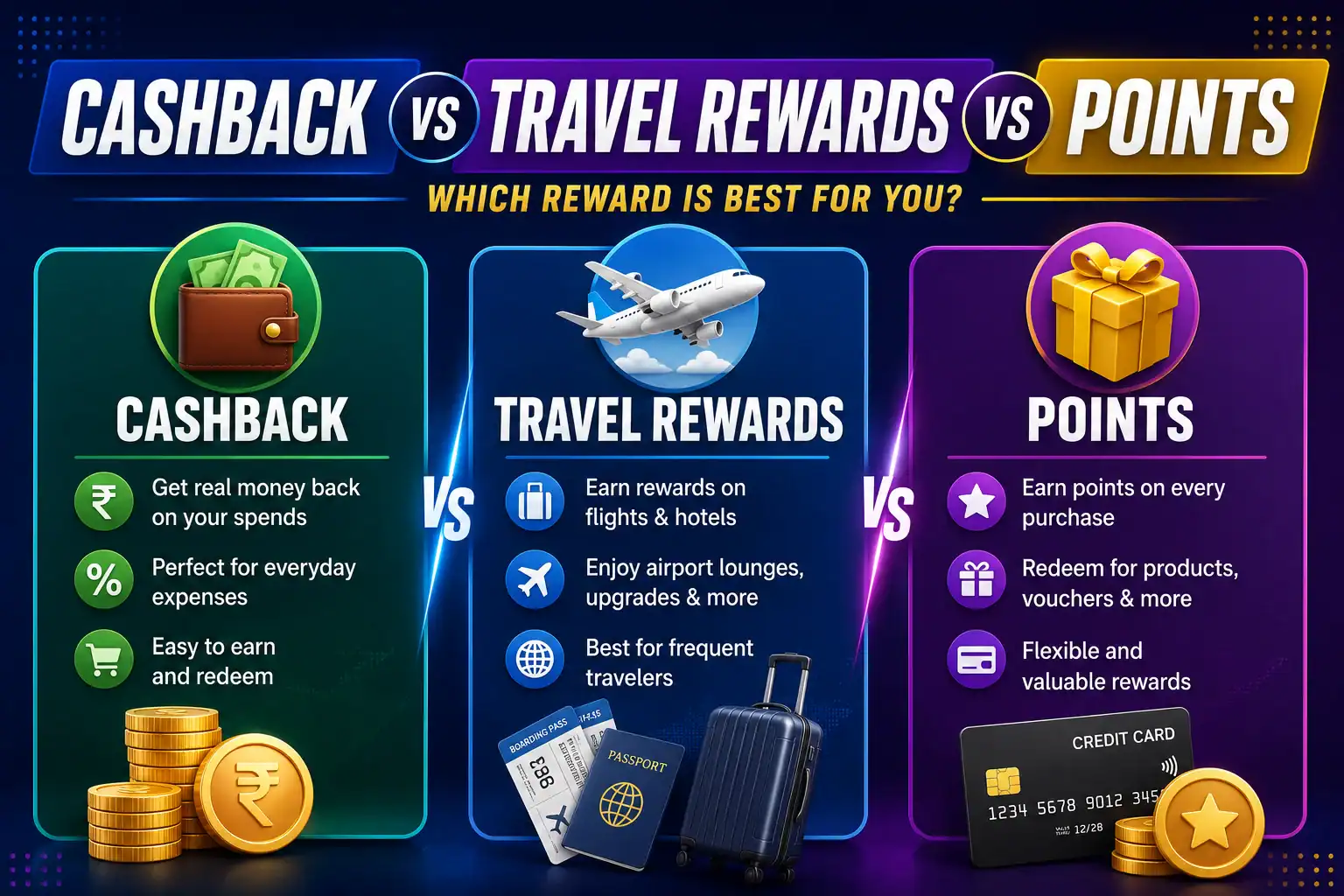
Nearly every rewards credit card falls into one of three reward structures, and understanding the difference is the first real decision point.
Cashback
You earn a percentage of each purchase back as statement credit or direct deposit. Simple, flexible, and easy to value — a dollar earned is worth a dollar, with no conversion math required.
Travel rewards
Points or miles earned are redeemed specifically for flights, hotels, or other travel. Often more valuable per point than cashback if redeemed well, but less flexible and easier to undervalue if redeemed poorly.
Flexible points programs
General-purpose points that can be redeemed for cash, travel, merchandise, or transferred to airline and hotel partners — a middle ground between simplicity and maximum value potential.
Neither category is objectively “better” — cashback tends to suit people who want simplicity and predictable value, while travel and flexible points programs tend to reward people willing to put in more effort to redeem strategically, often for outsized value on flights or hotel stays.
A quick way to decide between them
Ask yourself two honest questions: how often do you actually book flights or hotels in a typical year, and how much time are you willing to spend researching redemption strategies to get full value from points? If the honest answer to either is “rarely” or “none,” cashback will almost always net you more real value than a travel card, regardless of how attractive the points-earning rate looks on paper. Travel rewards only outperform cashback when you actually use them the way they’re designed to be used.
The Real Cost of a Credit Card
Every card has a cost side and a value side, and comparing offers means weighing both — not just looking at the flashiest sign-up bonus.
| Cost factor | What to check |
|---|---|
| Annual fee | Ranges from $0 to several hundred dollars for premium travel cards |
| APR | Only matters if you carry a balance — new offers commonly run in the low-to-mid 20% range |
| Foreign transaction fee | Often 1–3% per purchase abroad; many travel cards waive this entirely |
| Balance transfer fee | Typically 3–5% of the transferred amount, even during 0% intro APR periods |
| Late payment fee | A flat fee plus potential loss of any promotional APR |
A card with a $95 annual fee that earns 2% cashback breaks even at $4,750 in annual spending. Below that, a $0 annual fee card earning 1.5% cashback may actually net you more.
This kind of breakeven math is the single most useful habit for comparing cards objectively — it strips out marketing language and reduces the decision to actual numbers based on your own spending.
Types of Credit Cards by Category
Beyond the cashback-vs-travel split, cards are generally built around one of these core categories.
| Category | Best for | Watch out for |
|---|---|---|
| Flat-rate cashback | Simplicity, predictable earning on every purchase | Usually lower rate than category cards on your top spending areas |
| Category/rotating cashback | Big spenders in specific categories like groceries or gas | Requires tracking categories and sometimes manual activation |
| Premium travel | Frequent flyers who value airport lounges, travel credits, insurance | Higher annual fees only pay off with consistent travel |
| No annual fee travel | Occasional travelers who still want points without a yearly cost | Fewer premium perks, smaller earning rates |
| 0% intro APR / balance transfer | Paying down existing debt or financing a large purchase interest-free | Rate jumps sharply once the intro period ends |
| Secured / credit-building | Building or rebuilding credit history | Usually minimal rewards, may require a refundable deposit |
| Business cards | Separating business expenses, higher limits, business-specific perks | Personal guarantee often still required for approval |
Does the card network matter?
Beyond the issuer, cards also run on a payment network — most commonly Visa, Mastercard, American Express, or Discover. Acceptance is nearly universal for Visa and Mastercard worldwide. American Express and Discover have narrowed the acceptance gap significantly in recent years but can still be less widely accepted in some countries and at some smaller merchants, which is worth a quick check if a card’s rewards structure is otherwise appealing and you travel internationally or shop at independent retailers frequently.
How to Compare Two Cards Side by Side
Instead of trusting a “which is better” headline, run any two offers through the same checklist.
Match reward rates to your actual spending. A card with a high grocery cashback rate is worthless if you rarely cook at home. Pull up three months of your own statements before comparing.
Subtract the annual fee from projected rewards. Estimate what you’d realistically earn in a year, then subtract any fee to get the true net value.
Check the sign-up bonus requirement. A large bonus tied to an unrealistic spending threshold in a short window isn’t actually accessible value for most people.
Compare redemption flexibility. A slightly lower earning rate with simple, flexible redemption often beats a higher rate locked behind restrictive redemption rules.
Confirm the APR only if it might apply to you. If you plan to pay your balance in full every month, APR becomes largely irrelevant to your decision.
Reading the Fine Print That Actually Matters
Card terms and conditions are long, but only a handful of lines genuinely change the value of an offer.
Bonus category caps. Many cards offer an elevated rate like 5% cashback only up to a quarterly spending limit, dropping to a much lower rate afterward.
Redemption minimums and expiration. Some rewards programs require a minimum balance before redemption, or expire points after a period of account inactivity.
Intro APR end date, not just the rate. The promotional 0% period always has a hard end date, after which the standard APR applies retroactively to any remaining balance in some cases.
Authorized user and referral bonus rules. These vary widely by issuer and can add meaningful extra value if you know they exist.
Skimming straight to the “Rates and Fees” summary table required by regulation on most card applications is usually faster and more reliable than reading the full marketing page.
Grace periods and how interest actually gets charged
Most cards offer a grace period — typically around three weeks after your statement closes — during which you can pay your full balance and avoid interest entirely on that billing cycle’s purchases. Carry a balance past that grace period even once, though, and many issuers start charging interest on new purchases immediately, without a grace period, until you pay the full balance again for a full cycle. Understanding this mechanic is often more useful than memorizing a specific APR number, since it explains why occasionally carrying a small balance can end up costing more in practice than the headline rate suggests.
Choosing a Cashback Card
Cashback cards are the simplest category to evaluate because the math doesn’t require any conversion.
- Flat-rate cards suit people who want one predictable rate across every purchase without tracking categories.
- Tiered category cards suit people with a few dominant spending categories, like groceries or dining, where the elevated rate meaningfully outweighs a flat-rate alternative.
- Rotating category cards can offer the highest headline rates but require quarterly activation and category tracking, which some people find more effort than it’s worth.
For most beginners, a simple flat-rate cashback card is the easiest starting point — it removes decision fatigue and still earns a reasonable, predictable return on everyday spending.
Choosing a Travel Rewards Card
Travel cards can deliver outsized value, but only if your actual travel habits match what the card rewards.
Check whether points are airline/hotel-specific or transferable. Transferable points to multiple partner programs generally offer more flexibility than points locked to a single airline.
Value the included perks realistically. Lounge access, travel credits, and insurance only count if you’ll genuinely use them — don’t count perks you won’t actually use toward a card’s value.
Confirm there’s no foreign transaction fee if you travel internationally — this fee alone can erode most of what you earn abroad.
Estimate redemption value in cents per point, not just the number of points earned — the same number of points can be worth wildly different amounts depending on how you redeem them.
When an Annual Fee Is Worth Paying
Annual fees on premium cards have been rising, and industry data shows the average fee paid by those who do pay one has more than doubled over the past decade, even as fewer people overall choose to pay one at all. That split reflects a genuine shift: a smaller group of cardholders spending enough, or traveling enough, to make a higher fee worthwhile — and a much larger group better served by a fee-free card.
A simple rule of thumb: if the value of the perks and rewards you’ll actually use doesn’t clearly exceed the annual fee within a normal year of spending, a no-annual-fee alternative is usually the better fit.
It’s also worth revisiting this calculation periodically rather than treating it as a one-time decision. Spending habits shift — a card that made sense when you traveled frequently for work may no longer earn its keep after a job change, and it’s easy to keep paying an annual fee out of habit long after the value has faded. Many issuers will let you downgrade to a no-fee version of the same card rather than canceling outright, which preserves your credit history while cutting the ongoing cost.
Credit Score and What It Unlocks
Your credit score doesn’t just affect approval odds — it directly shapes which cards and terms you’ll even be offered.
| Credit range | Typical access |
|---|---|
| Excellent (740+) | Best rewards rates, premium travel cards, lowest available APRs |
| Good (670–739) | Most standard rewards cards, moderate approval odds on premium cards |
| Fair (580–669) | Limited rewards options, higher APRs, some secured card requirements |
| Building / limited history | Secured or student cards, focused on building history rather than rewards |
Applying for multiple cards in a short window can temporarily lower your score through hard inquiries, so it’s generally worth spacing out applications rather than applying broadly to compare offers in practice.
Beyond the score itself, issuers also weigh income, existing debt, and credit history length when approving applications and setting credit limits — two applicants with the same score can receive very different offers based on these additional factors. This is why pre-qualification tools, which most major issuers now offer, are worth using before a formal application: they typically show your approval odds using a soft inquiry that doesn’t affect your score, letting you gauge your chances before committing to a hard inquiry.
Building a Multi-Card Strategy
Once you’re comfortable managing one card responsibly, pairing two or three cards strategically can meaningfully increase your total rewards without adding much complexity to your monthly routine.
The everyday pair
A flat-rate cashback card for general spending, paired with a category card that boosts your one or two highest spending areas — often groceries, gas, or dining.
The traveler’s pair
A no-foreign-transaction-fee travel card for booking flights and hotels, paired with a cashback card for everyday domestic spending that doesn’t earn bonus travel points.
The key to making a multi-card approach actually work is keeping it simple enough to remember — two or three cards with clear, distinct purposes tends to outperform five or six cards with overlapping, forgettable rules. If you find yourself unsure which card to use for a given purchase, that’s usually a sign the strategy has gotten more complicated than the extra rewards are worth.
Common Mistakes When Choosing a Card
| Mistake | Why it hurts |
|---|---|
| Chasing the sign-up bonus alone | A great bonus on a card that doesn’t match your ongoing spending still nets less over time |
| Ignoring the annual fee math | A rewards rate that sounds high can still net negative once the fee is subtracted |
| Carrying a balance on a rewards card | Interest charges from a 20%+ APR overwhelm almost any rewards earned |
| Letting points expire | Some programs void unused points after a period of account inactivity |
| Applying for too many cards at once | Multiple hard inquiries in a short period can temporarily lower your credit score |
| Overvaluing perks you won’t use | Unused lounge access or travel credits don’t offset a real annual fee |
Maximizing Rewards Once You Have a Card
Pay the full statement balance every month. This is the single biggest lever — it makes the APR irrelevant and lets rewards earned stay pure profit rather than being offset by interest.
Match cards to categories if you hold more than one. Using a dedicated grocery card for groceries and a dedicated travel card for flights consistently earns more than using one card for everything.
Redeem before value erodes. Some points and miles programs quietly devalue their redemption rates over time — using rewards within a reasonable window tends to preserve more value.
Set a calendar reminder for annual fee dates. Reassess each year whether the card’s value still exceeds its cost, and consider downgrading or canceling if it doesn’t.
Stack rewards with shopping portals when it makes sense. Many issuers run their own online shopping portals that add extra cashback or points on top of your card’s normal rate for purchases made through them.
None of these habits require dramatically changing how you spend — they’re mostly about routing your existing spending through the right card and staying consistent about paying in full. Small, boring habits like these tend to add up to real annual value with almost no added effort once they’re set up.
Frequently Asked Questions
Is a cashback card or travel card better?+
Is it worth paying an annual fee for a credit card?+
Does applying for a credit card hurt my credit score?+
What credit score do I need for a good rewards card?+
Should I close a card I no longer use?+
Can I have more than one rewards credit card?+
Conclusion
The “best” credit card in 2026 isn’t a single product — it’s whichever card’s reward structure, fee, and perks best match how you actually spend and travel. A high-earning card that doesn’t fit your spending habits, or a premium card whose perks go unused, quietly underperforms a much simpler option that actually aligns with your life.
Run any offer you’re considering through the comparison framework in this guide — reward rate against real spending, annual fee against realistic value, and APR against whether you’ll ever actually carry a balance. That process will serve you better over time than chasing whichever card currently tops a “best of” list, since those lists change as fast as the offers themselves.
If you’re still narrowing things down, start with the two or three cards that best match your top spending categories, run the breakeven math from earlier in this guide on each, and let the numbers — not the marketing copy — make the final call.
